Research
RNA Polymerase III Transcription
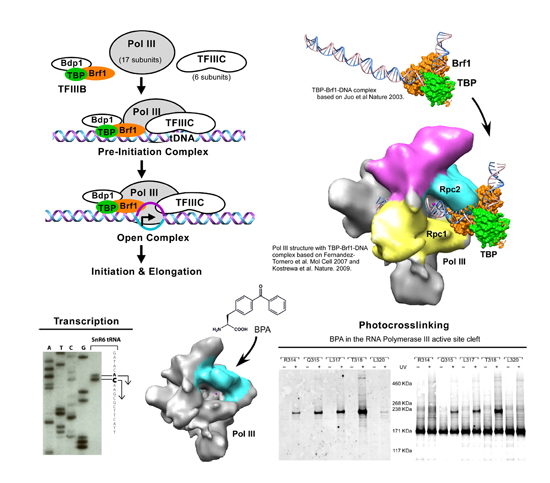
The research focus of our group is to understand the mechanism of RNA polymerase III (Pol III) transcription in the yeast Saccharomyces cerevisiae. Pol III transcribes tRNAs, 5S ribosomal RNA, and certain small nuclear RNAs. Transcription factors TFIIIA, TFIIIB, and TFIIIC recruit Pol III to assemble the initiation complex at the gene promoter, and subsequently this complex undergoes conformational change to form the open complex, allowing the single-stranded DNA template to be positioned inside the Pol III active site for DNA/RNA base-pairing. Exactly how these proteins establish precise inter-molecular interactions within the initiation complex and how the protein/DNA complex is structurally organized are still unclear. To address these questions, we are currently applying site-specific photocrosslinking and hydroxyl-radical probing to identify protein interactions within fully assembled and functional Pol III initiation complex. Polypeptides predicted to function in regulating DNA opening and transcription start site selection are subjected to extensive site-directed mutagenesis to incorporate biochemical probes to map protein interaction sites within the initiation complex. Our ongoing site-directed biochemical projects are briefly described as follows:
(A) Bdp1 subunit of TFIIIB
A series of single cysteine variants were generated to conjugate with the hydroxyl radical reagent FeBABE at surface cysteine positions in the highly conserved SANT domain of Bdp1. These FeBABE-Bdp1 mutants will allow us to map the binding site of the SANT domain within the initiation complex for explaining how this conserved domain functions in recruitment and possibly in DNA opening process.
(B) Brf1 subunit of TFIIIB
We are using the non-sense suppressing method developed by P Schultz group (the Scripps Research Institute) to incorporate the non-natural amino acid photocrosslinker p-Benzoyl-L-Phenylalanine (BPA) to positions in several Brf1 functional domains such as the N-terminal ribbon and cyclin repeats as well as the C-terminal conserved sequence blocks. By utilizing these BPA-Brf1 mutants in initiation complex formation and photocrosslinking, we can identify more complete protein interactions for Brf1.
(C) Rpc1 and Rpc2 subunits of Pol III
Rpc1 and Rpc2 form the active site cleft of Pol III and are in close contacts with subunits of TFIIIB and TFIIIC to position the promoter DNA and separate DNA strands to form the open DNA. The photcrosslinker BPA is incorporated into Rpc1 and Rpc2 to identify proteins interacting with the Pol III active site cleft.