Dr. Hsin-Fang Yang-Yen ·¨©ÊªÚ³Õ¤h

Research Fellow, IMB

Research

I. Cytokine signaling in hematopoietic cells

We have been studying mechanisms responsible for the survival functions of IL-3/GM-CSF by looking for survival genes that are activated by these two cytokines in hematopoietic cells. Two genes (mcl-1 and osteopontin) have been identified and their roles in cytokine survival effects have been extensively studied. By promoter analysis, we have further delineated the signaling pathways from receptor activation to mcl-1 gene transcription. To further study the physiological functions of Mcl-1, the following strategies are currently being undertaken:

1. Characterization of Mcl-1 interacting proteins

The yeast two-hybrid approach has been employed to identify Mcl-1-interacting protein(s). Two proteins (TCTP and Tom70) have thus been characterized. While TCTP enhances Mcl-1¡¦s stability, Tom70 facilitates Mcl-1 targeting to mitochondria. Our current direction for this part is to characterize the physiological significance of these protein-protein interactions by biochemical analyses as well as by generation of a few mutant mouse models.

2. Generation of Mcl-1 hypomorph and conditional alleles

IL-3 stimulation of mcl-1 gene transcription in hematopoietic cells is mainly mediated through two promoter elements, SIE and CRE-2 sites. Each element contributes to approximately 50% of IL-3 inducibility, and mutation of both elements results into a promoter that has completely lost its IL-3 response. To examine the functional roles of these two promoter elements in an animal system, mice with targeted mutations of CRE-2 and/or SIE elements have been generated. All homozygous mutants are viable and appear to be developmentally normal. However, mutation of both the CRE-2 and SIE sites has resulted into mutant mice (SC mutant) that manifest a hypomorphic phenotype only in the T cell but not other cell lineages examined. The SC promoter knockin mice turned out to be a novel mouse model to study Mcl-1 functions during T cell development as well as for studying cell-lineage specific regulation of Mcl-1 expression.

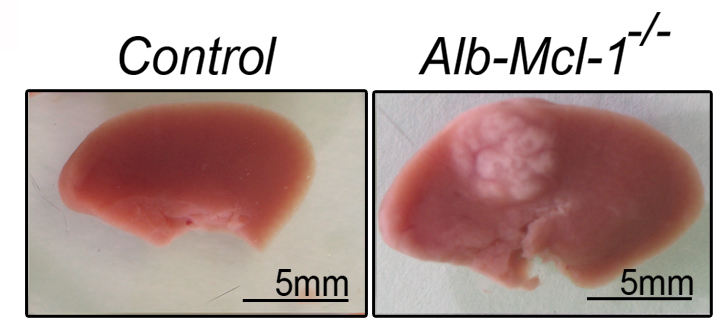
To study Mcl-1 functions in other tissues, mice bearing a conditional allele of mcl-1 have been generated. Conditional deletion of Mcl-1 in cell-types other than T cells is currently under investigation.

II. Survival signaling in the small intestinal system.

EF-L1 is a cytokine-like factor that was fished out in our SAGE screen for maternal factors that may regulate embryo implantation and survival. To study EF-L1 functions in vivo, mice with targeted mutation of the EF-L1 gene have been generated. Interestingly, this mutant mouse line did not manifest any abnormal phenotype in female pregnancy. However, it manifests a defect in maintaining the survival of the intestinal epithelial cells (IEC). We also unexpectedly identified a role of EF-L1 in host defence. Current study focuses on dissecting the detailed mechanism(s) by which EF-L1 mediates IEC survival as well as facilitates bacterial invasion into host cells.