Contact
- mbfelix@imb.sinica.edu.tw
- (L) 886-2-2789-9340
- N509, Institute of Molecular Biology, Academia Sinica
Research
Interleukin (IL)-15 and Lymphocyte Biology
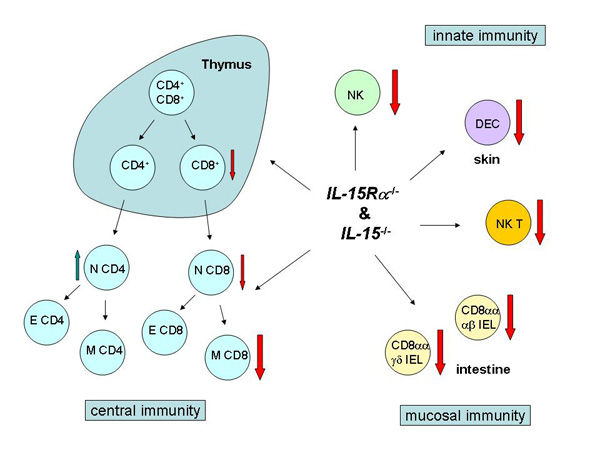
IL-15 is widely expressed by different types of cells in various tissues with its high affinity receptor α, IL-15Rα. IL-15 and IL-15Rα form complex in the ER and subsequently displayed on the cell surface, which signal through IL-15Rβγ on juxtaposing cells. This mode of action is essential for the homeostasis and function of several lineages of lymphocytes. We have been interested in the function of IL-15 in different tissues and the development of its translational use.
I. Thymic IL-15 and T cell development
We found that IL-15Rα is preferentially expressed by the MHC-IIhi antigen presenting cells (APCs) in the thymic medulla, including dendritic cells and epithelial cells (TEC). The IL-15 system of thymic APCs posi- tively regulates thymocyte negative selection, while the TEC IL-15 system negatively regulates the homeo- stasis of natural TH17 thymocytes. CD4+ thymocytes of Il15-/- and Il15ra-/- mice induce autoimmune phenotypes when transferred into nude mice. Aged Il15-/- and Il15ra-/- mice develop a late-onset autoimmune phenotype that resembles Sjogren’s syndrome. Therefore, thymic IL-15 represents a new layer of regulation in T cell-mediated autoimmunity. We also found that TEC IL-15 positively regulates the development and function of thymic invariant natural killer T cells.
II. IL-15 blockade for the treatment of cerebral ischemia reperfusion (IR) injury
Ischemia stroke upregulates the level of IL-15 in brain astrocytes. We found that IL-15 protects astrocyte from oxygen glucose deprivation-induced death in vitro. Il15−/− mice show a smaller infarct volume and lower numbers of activated brain infiltrating natural killer (NK), CD8+ T, and CD4+ T cells compared to wild type (WT) mice after cerebral IR. Post IR IL-15 blockade with antibody reduces infarct size, improves motor and locomotor activity, and reduces the effector function of NK, CD8+ T, and CD4+ T cells in the IR brain of WT mice. Therefore, ablation of IL-15 responses after cerebral IR ameliorates brain injury in adult mice.
NK Cell for Cancer Immunotherapy
Human and mice with reduced level or function of NK cell show enhanced cancer incidence and progression. NK cell activated by tumor cell produces IFN-γ, the key cytokine driving type 1 immune response that is essential for effective anti-tumor immunity. However, autologous NK cell therapy had shown little clinical benefit. We hypothesize that the heterogeneity of NK cells and the immunosuppressive microenvironment in tumor are the major causes for the limited efficacy of autologous NK cell therapy. We established a method to generate NK cells with anti-tumor activity ex vivo. In a tumor-resected metastatic mouse model, we found that autologous NK cell therapy promotes survival of tumor-resected mice. We are developing combination therapy to improve the efficacy of autologous NK cell therapy and to study the mechanisms governing the success and failure of the therapy.