Research
Analysis of Carbohydrate Metabolism Mutants of Arabidopsis
Carbohydrate synthesis and subsequent utilization are among the most fundamental processes in plants. We isolated Arabidopsis mutants with altered starch content in leaves and applied the reverse genetics, to study genes involved in starch metabolism and their roles in plant development. These approaches resulted in the discovery of previously unknown genes (e.g. SEX1, DPE2, and MEX1) essential for leaf starch degradation.
Alpha-amylase is thought to be the enzyme initiating the degradation of starch granules. However, Arabidopsis planted without alpha-amylases have no distinct phenotype from the wild type. To understand the function of Arabidopsis plastidic alpha-amylase (At1g69830), we generated transgenic plants overexpressing the C-terminal catalytic domain of alpha-
amylase in plastids. These transgenic plants have pale green leaves, little starch accumulated, and stunted growth, suggesting that regulation of starch synthesis and degradation is important for a normal plant development. We have isolated revertants and will identify downstream genes responding to altered starch metabolism.
Metabolite reallocation within cells and among cells can be an important regulatory factor for carbohydrate metabolism. Normally, carbon fixed in chloroplasts will export to cytosol. However, we found that Arabidopsis treated with trehalose can induce G6P transporter (GPT2) expression and transport cytosolic glucose 6-phosphate (G6P) to chloroplasts for starch synthesis. G6P can play a pivotal role in carbon metabolism; however, the regulation of G6P flux is not fully explored. Studies of G6P flux by manipulation of genes related to G6P metabolism are in progress.
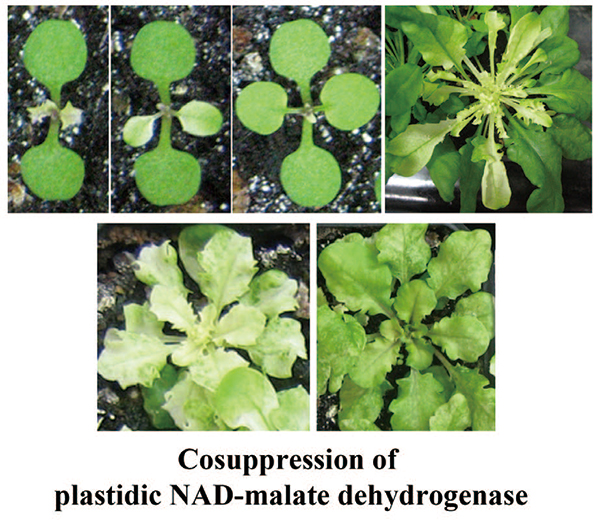
Reductants generated in chloroplasts (e.g., NADH and NADPH) must be transferred to cytosol via various shuttles, e.g. malate valve. We found that plastidic NAD-dependent malate dehydrogenase (pMDHN) can interact with LSF2 and BAM1, forming a complex with a mysterious unknown role in starch metabolism. Phenotypes of T-DNA knockout and amiRNA knockdown mutants indicate that pMDHN is essential for Arabidopsis embryo and chloroplast development. pMDHN activity cannot be substituted by plastidic NADP-dependent malate dehydrogenase. It cannot be rescued by exogenous supplemented sugars either. We are unraveling what the signal derived from pMDHN for chloroplast development is.
We also found temporal and spatial coordinated expression of several starch metabolism genes in plants. Transcription regulation of starch metabolism genes is the primary mechanism of this coordinated expression; nevertheless it remains largely unknown. It would be noteworthy to identify transcription factors for starch metabolism genes.