Contact
- mbyhsun@gate.sinica.edu.tw
- (O) 886-2-2788-3605
(L) 886-2-2789-9211 - 8B02, Interdisciplinary Research Building, 8th Floor
Research
Molecular Mechanisms Regulating Drosophila Visual System Development
My lab is interested in the molecular mechanism controlling the development of the visual system in Drosophila. We are primarily studying (1) specification of the eye fate and its segregation from antenna fate, (2) neuron-glia interaction, and (3) ingrowth of tracheal into the growing eye.
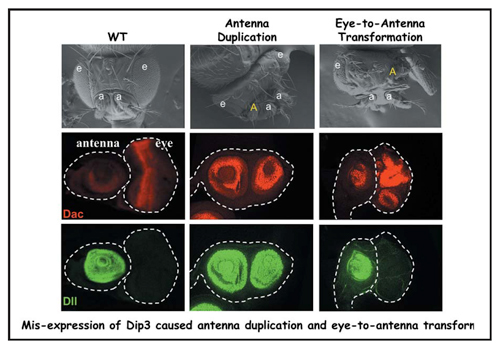
The Drosophila eye and antenna arise from a single epithelium disc called the eye-antennal imaginal disc. Genes specifying the eye fate and antenna fate have been identified. We are studying the mechanism for subdividing this disc into distinct eye and antennal field, the interaction between the two parts, and the establishment and maintenance of their boundary.
We are also studying the interaction between the eye and the brain, specifically the interaction between the photoreceptor neurons and glia cells from the brain, including glia in the optic lobe of the brain and the retinal basal glia (RBGs) that migrate from the brain into the eye disc. We are studying the mechanisms regulating the proliferation, survival, migration and distribution of the glia within the visual system, and also their effects on photoreceptor development and functions. We also found that the adult photoreceptors send a survival signal to the optic lamina in the brain to maintain the survival of glia in its target field.
As the eye grows larger, the need for oxygen increases. We found that trachea extends into the growing eye during the pupal stage. The retinal cells secret a FGF ligand to induce the ingrowth of trachea. We are investigating the molecular mechanism regulating this process, and its relationship to hypoxia.