
Contact
- mbwen@ccvax.sinica.edu.tw
- (O) 886-2-2788-3629
(L) 886-2-2789-9230 - 525, Institute of Molecular Biology, Academia Sinica
Research
Virus Entry and Host Cell Signaling
Vaccinia Virus Entry
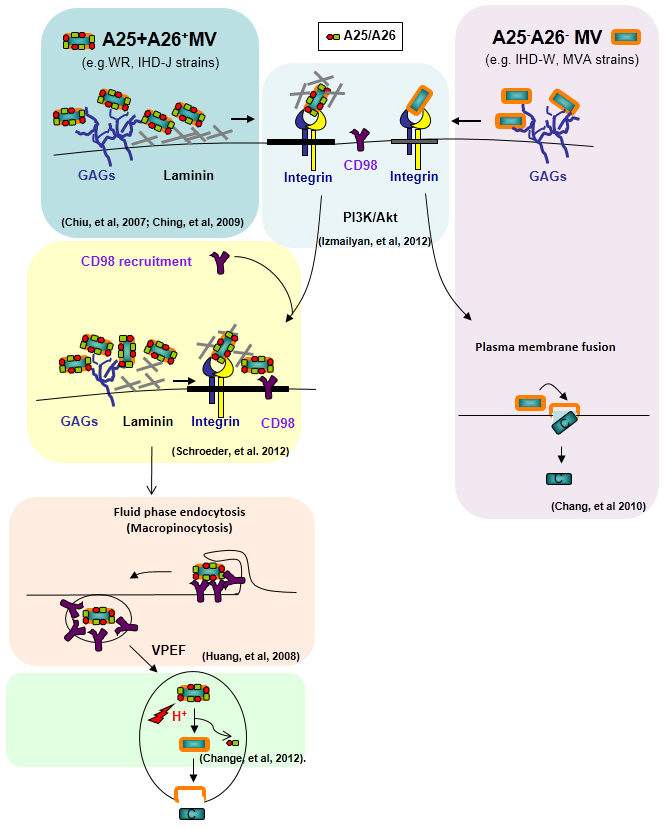
Vaccinia virus (VV) is a large enveloped DNA virus and belongs to the poxvirus family. VV has a wide host range and infects different cell types in vitro and in vivo. VV enters cells by membrane fusion and no receptor was identified yet. We have demonstrated that vaccinia virus contains three envelope proteins,A27L, H3L and D8L, for binding to cell surface heparan sulfate (HS) and chondroitin sulfate (CS). Recently, we undertook a proteomic approach and determined the vaccinia virus proteome. Novel envelope proteins are identified and their roles in virus entry are currently under investigation. In addition, we have shown that vaccinia virus penetrates into cells through plasma membrane lipid rafts which act as platforms for signaling regulation. We have identified a cellular molecule that is specifically recruited to lipid rafts during virus entry and is required for virus penetration into cells. Further studies will shed light on the molecular mechanism of virus penetration, uncoating and intracellular trafficking in cells. |
 |