Contact
- mcyao@imb.sinica.edu.tw
- 886-2-2789-3117
- 230, Institute of Molecular Biology, Academia Sinica
Research
Genome Instability and RNA Interference in Eukaryotes
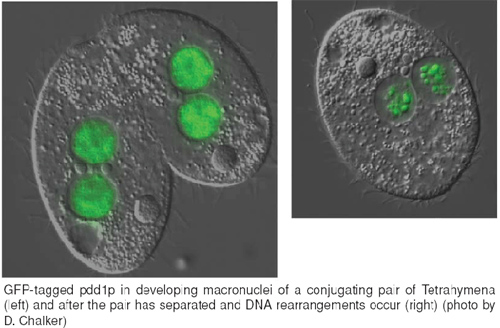
This laboratory focuses on molecular processes that affect genome stability, and the roles of non-coding RNA in these processes. Genome instability drives biodiversity through evolution, and contributes to human diseases particularly cancers. Various forces including intrinsic and environmental factors affect genome integrity. To gain better understanding of this fundamental issue, we have been investigating processes that alter gene or genome structures in a programmed manner, processes that have been known to generate vertebrate adaptive immunity and yeast mating type switching. We use the ciliated protozoan Tetrahymena thermophila as a primary model for this analysis. Ciliates including Tetrahymena carry out unparalleled extensive DNA rearrangements during somatic nuclear differentiation, including chromosome breakage at hundred of specific sites, deletion of thousands of specific DNA segments and amplification of the ribosomal RNA gene. They offer exceptional opportunities to understand the molecular basis of genome instability. We have identified critical cis-acting sequences that regulate these processes, including a 15 bp sequence for chromosome breakage sites, two sets of sequences for DNA deletion boundaries, and a pair of inverted repeats for large DNA palindrome formation during gene amplification. We have also identified chromosomal proteins involved in their regulations.
Recent studies indicate that DNA deletion in Tetrahymena is a remarkable specialized RNAi process. Before DNA deletion occurs, double strand RNAs are transcribed from corresponding sequences and processed into 27nt siRNA, which cause modifications of chromatin, including H3K9 and H3K27 tri- methylation, during nuclear differentiation. The marked chromatin formed heterochromatin similar to other organisms, but in Tetrahymena the process goes one-step further - the marked DNAs are precisely deleted using a domesticated transposase. Thus, DNA deletion is regarded as an ultimate form of gene silencing, probably evolved to defend against invading genetic agents such as viruses and transposons. We are also investigating the possible roles of other chromosomal proteins, and have established genetic and cytological approaches to search for new genes involved in these processes.
The mechanism of gene amplification found in Tetrahymena likely also occurs in other organisms. We found that large DNA palindromes can be produced in the budding yeast and mammalian cells, just like in Tetrahymena, when a double stranded DNA break is made at a site adjacent to a pair of short inverted repeats. We have also successfully tested this idea in cultured mammalian cells. This finding suggests a general mechanism for gene amplification in eukaryotes. Using this concept we have developed a genome-wide detection method to examine the role of inverted repeats in human cancer progression, which is often accompanied by gene amplification.