Resveratrol isomers with opposing activities target endonuclease G to modulate neurodegeneration and mitochondrial elimination
Dr. Yuan, Hanna S. - June, 2026
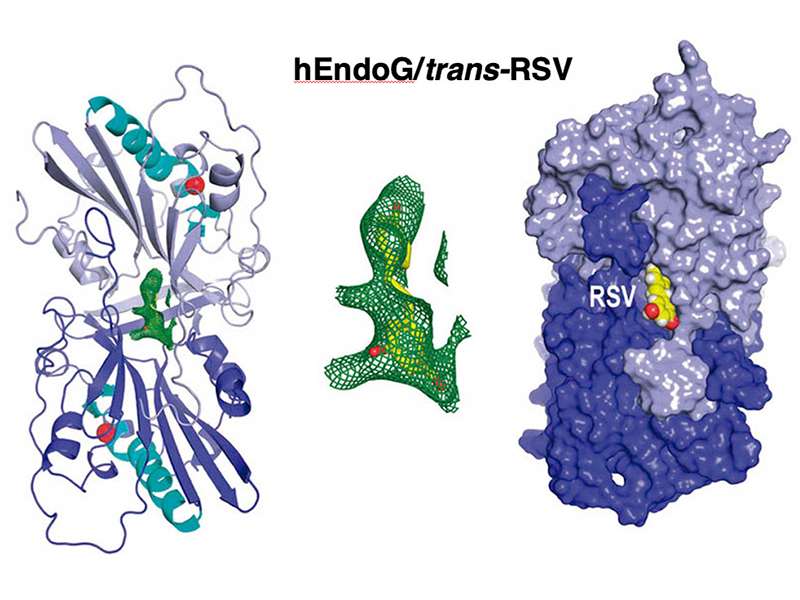
Mitochondrial endonuclease G (EndoG) is involved in several important cellular processes and has been implicated in multiple diseases. Accordingly, molecules modulating EndoG activity may have high therapeutic potentials. Searching for compounds affecting paternal mitochondrial elimination (PME) in Caenorhabditis elegans, we have identified resveratrol (RSV), a well-known natural compound, as a PME inhibitor. Interestingly, RSV exists as a mixture of trans- and cis-isomers, which interconvert upon light exposure and, surprisingly, exhibit opposing effects on PME by targeting nematode EndoG. Biochemically, trans-RSV enhances and cis-RSV inhibits endonuclease activity of EndoG through direct binding to EndoG. In cellular thermal shift assays, trans-RSV stabilizes and cis-RSV destabilizes nematode EndoG in vivo, indicating direct physical interactions between RSV isomers and EndoG. Structurally, two cis-RSVs bind to the His-Me finger DNA-binding motifs of the EndoG dimer, obstructing its access to DNA substrates. In contrast, trans-RSV binds to the EndoG dimeric interface to stabilize the EndoG dimer. Functionally, trans-RSV enhances and cis-RSV inhibits dopaminergic (DA) neuronal loss induced by α-synuclein, consistent with an important role for EndoG in α-synuclein-induced Parkinsonism. In a mouse model of Parkinson’s disease, cis-RSV treatment inhibited DA neurodegeneration in the substantia nigra and improved motor symptoms of animals. Our study demonstrates unexpected, opposing effects of RSV isomers on EndoG in regulating its nuclease activity and associated biological processes, which could complicate RSV applications and cause unanticipated toxicity and side effects. However, when used properly, RSV isomers hold promise as targeted therapies for EndoG-associated human diseases, including PME-related disorders and neurodegeneration.