Cell Cycle-Specific Regulation of Centrosome Clustering Dynamics in Cancer Cells by the Multifunctional Kinesin HSET
Dr. Hsia, Kuo-Chiang - March, 2026
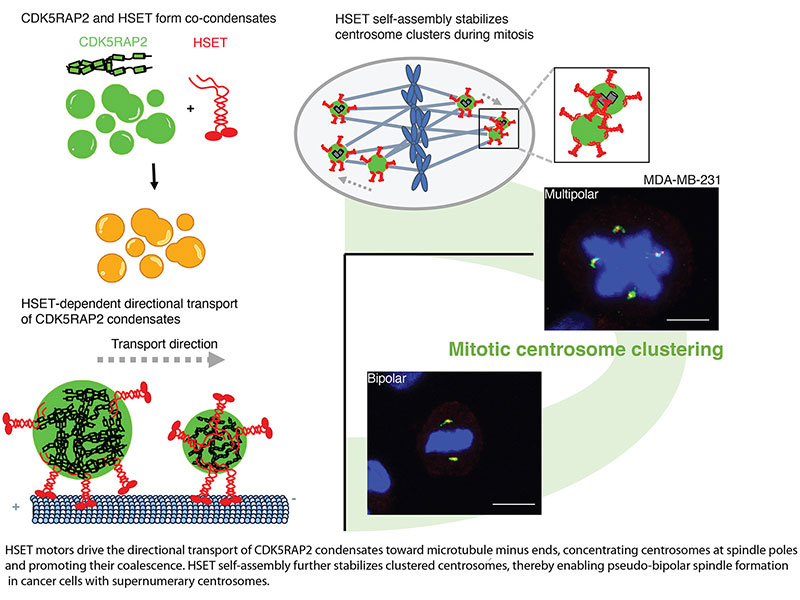
Centrosome amplification in cancer cells generates excess centrosomes that must cluster to enable bipolar cell division. Here, we demonstrate that the mitotic kinesin HSET actively transports condensates formed by the centrosomal protein CDK5RAP2 toward microtubule minus ends, concentrating centrosomes at spindle poles and promoting their coalescence. In addition, HSET’s ATP-independent self-assembly prevents centrosome declustering, thereby maintaining centrosome integrity during mitosis. Together, these findings show that HSET reguates centrosome clustering dynamics and preserves centrosome organization in cancer cells, highlighting its potential as a therapeutic target. This study was published on March 6, 2026, in Advanced Science. The research was led by Dr. Kuo-Chiang Hsia (Academia Sinica) and Mr. Po-Pang Chen, a graduate student at National Yang-Ming Chiao-Tung University, in collaboration with Dr. Sheng-Hong Chen, Dr. Chien-Ling Lin, Distinguished Professor Yu-Chun Lin, and Professor Su-Yi Tsai. The work was supported by Academia Sinica (Investigator Award) and the National Science and Technology Council.
微管馬達蛋白如何聚集癌細胞中多餘的中心體
癌細胞常出現中心體數量異常增加的現象。為避免細胞分裂錯誤,癌細胞可透過「中心體聚集」機制,將多個中心體集中為兩個群體,使細胞仍能順利分裂並持續增殖。然而,其背後的分子機制仍未釐清。本研究發現,微管馬達蛋白 HSET 可與中心體蛋白 CDK5RAP2 形成凝聚體,並沿微管主動運輸至細胞分裂紡錘體兩端,促進多餘中心體聚集並維持穩定。此外,HSET 亦具有不需消耗 ATP 的自我組裝能力,可防止中心體再次分散。此研究揭示 HSET 在癌細胞中心體聚集與穩定中的關鍵角色,並顯示其具有潛在抗癌治療標靶的研究價值。 本研究成果於 2026 年 3 月 6 日發表於國際期刊 Advanced Science(先進科學)。研究由中研院分生所 夏國強研究員 與陽明交通大學生化與分生所博士候選人 陳博邦 主導,並與分生所 陳昇宏與林倩伶副研究員,清大分醫所 林玉俊特聘教授 及臺大生科系 蔡素宜教授 合作完成。研究經費由中研院深耕計畫與國科會計畫支持。