Rad51, Rad54, and ZMM proteins antagonize the mismatch repair system to promote fertility of budding yeast intraspecies hybrid zygotes
Dr. Wang, Ting-Fang - September, 2025
Rad51 and meiosis-specific Dmc1 catalyze homologous recombination (HR) between maternal and paternal chromosomes during meiosis in many sexual eukaryotes, generating three interhomolog (IH) recombination products: non-crossovers (NCOs), class I interference-sensitive crossovers (COs), and class II non-interfering COs. CO interference suppresses relatively close CO formation. Some COs form chiasmata, which physically connect homologous chromosomes and ensure proper chromosome segregation during meiosis I. Meiosis is highly relevant to speciation, with the mismatch repair (MMR) system believed to prevent IH recombination, leading to post-zygotic isolation between closely related species. We report that several Saccharomyces cerevisiae homologous recombination proteins exhibit anti-MMR activities, including Rad51, Rad54, Rad59, and synapsis-promoting ZMM proteins (Mer3, Zip1, Zip4, and Msh4) in SK1/S288c hybrid meiosis. Srs2 (an ortholog of Escherichia coli helicase UvrD) facilitates MMR by dissembling Rad51–single-stranded DNA pre-synaptic filaments. Rad51 antagonizes MMR and Srs2. Rad54’s anti-MMR activity acts after Srs2 and outcompetes its pro-HR function to promote Rad51-mediated IH-HR in hybrid meiosis. Dmc1 and Rad51 then recruit pro-crossover ZMM proteins to promote class I IH-CO formation while limiting MMR to promote NCO formation by Sgs1 (an ortholog of E. coli RecQ helicase) and prevent class II IH-CO formation by the Mms4–Mus81 endonuclease.
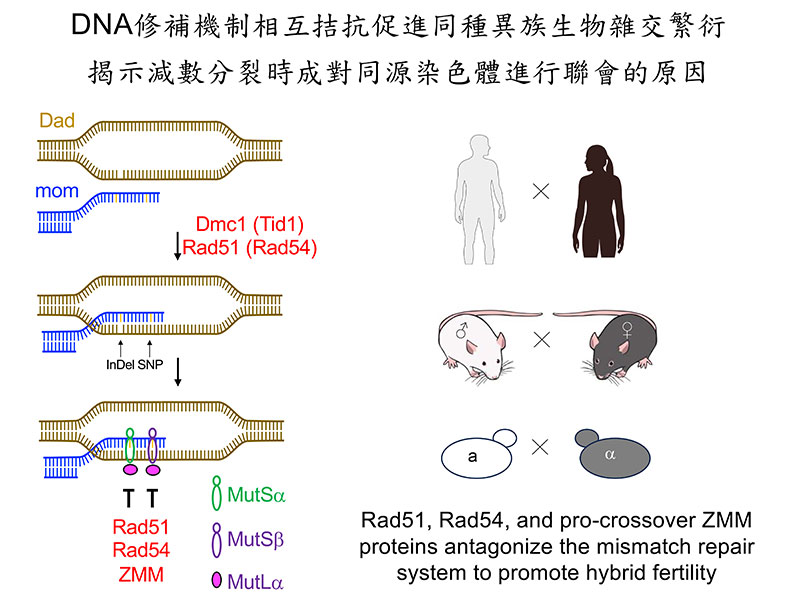
錯誤配對鹼基修復(mismatch repair; MMR)與同源重組(homologous recombination; HR)是生物修復DNA破損與錯誤配對鹼基的機制,發生異常,常導致癌症、發育不良與不孕等疾病。過去30餘年,生物學界普遍認為MMR單方面抑制HR,是相近不同物種(馬與驢)發生生殖隔離與子代(騾)不孕的主因。本院分子生物研究所王廷方研究員研究團隊,發現催化HR的Rad51、Rad54與「聯會複合體(Synaptonemal complex)」ZMM蛋白質均能拮抗MMR的活性,是同種異族生物雜交繁衍不可或缺的要件。聯會複合體是拉鍊狀的蛋白質結構,發現迄今80年,僅在減數分裂前期形成,負責識別與配對成對同源染色體,將兩者側向連接併排聯會在一起,促進HR與同源染色體互換(crossing-over),增加精子、卵與真菌有性孢子的基因多樣性,本研究重塑我們對減數分裂、DNA修復、優生育種、生物演化與癌症治療的理解。
本論文2025年9月3日發表於「核酸研究(Nucleic Acids Research)」期刊,由分子生物研究所王廷方研究員主導,並與同所薛一蘋特聘研究員和嘉義大學副校長陳瑞祥教授合作。研究經費由本院關鍵突破種子計畫與國科會專題研究計畫補助。